

 |
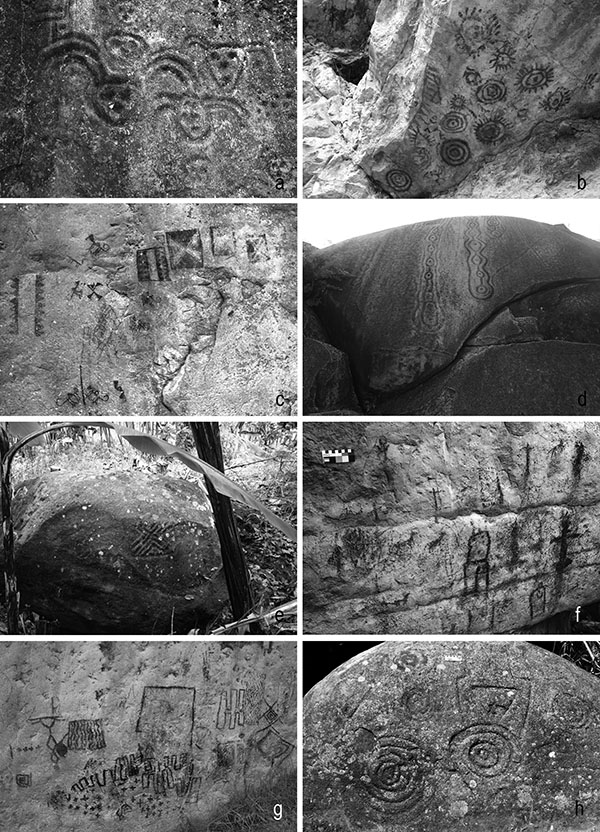
| Fig. 1. Some of the Colombian rock art sites documented in the last few years. a. San Jacinto, (Bolívar), b. Sáchica (Boyacá), c. Sutatausa (Cundinamarca), d. Floridablanca (Santander), 4. e. Zipacón (Cundinamarca), f. Cucunubá (Cundinamarca), g) Sutatausa (Cundinamarca), h. Chinchina (Caldas). Diego Martínez C., 2006-2010, Pedro Argüello, 2009. |
 |
Chronology is one of the
most challenging topics in rock art research around the world (Whitley 2005).
Although the dating of rock art is not a goal in itself, it is a fact that
chronological accuracy is pivotal in order to understand the social context in
which rock art was produced and used (Argüello 2008, 2009). In Colombia, almost
all attempts to explain rock art have been made without a solid chronological
basis. This lack of dating has not allowed the building of a credible explanation
of rock art’s context. There is a general tendency to assign rock art to the
Indian groups described by Spanish chronicles during the 16th century, without
taking into consideration the fact that the places in which rock art exists
were populated for at least 10,000 years (Correal & Van der Hammen 1977).
Over such a long period of time diverse groups with political, economic and
cultural differences settled here in succession.
Contrary to the worldwide
tendency for a growing number of archaeologists to be interested in the study
of rock art, in Colombia the increasing number of archaeologists is inversely
proportional to the number of them studying rock art (Jaramillo & Oyuela-Caycedo 1995). Although several archaeological
publications contain information about this subject, in most cases rock art is
not integrated with the problems treated by archaeologists in their analyses
and just constitutes an addendum to the archaeological reports (i.e. Langebaek & Piazzini 2003:
70; Mora 2003: 85). Part of this situation has its origins in the incapacity of
archaeologists to assign chronology to rock art, which prevents them linking it
to other archaeological material. And to some extent it is the result of the
Colombian academic tradition that has assigned a privileged role to other kinds
of archaeological evidence (i.e. ceramics, lithics)
as a source of information about the past.
In recent years, two
research projects have been carried out with the explicit aim of understanding
rock art in an archaeological context (Castaño &
Van der Hammen 2006; Argüello 2009). To determine what an archaeological perspective in rock art research
implies is a difficult task because of the plurality and diversity of
archaeological approaches (e.g. Chippindale & Taçon 1998). However, these two projects appeal to a traditional archaeological
approach consisting of the recovery of archaeological material near rock art
sites as a way to contextualise and date related
activities. Although their results are preliminary and not necessarily
conclusive, these projects have shown that, in fact, it is possible to recover
the remains of activities that were possibly linked to the production and use
of rock art, and they have opened the door to a promising perspective for an
archaeological association of rock art.
Although archaeological
excavations close to rocks with paintings and petroglyphs are at present
limited in number, they have demonstrated the diversity of contexts in which
rock art was involved. Excavations by Castaño &
Van der Hammen (2006) of rock-shelters in Chiribiquete (southeastern rainforest region) suggest that
such sites were constantly visited –but were not habitation sites–
and ritual and ceremonial activities were probably carried out in immediate
vicinity of panels with rock paintings. Such activities, according to the
authors, would be related to “shamanic” activities. The “shaman”’s presence would be corroborated by the formal characteristics of the paintings
– representation of phosphenes, “shamanic”
animals, and ritual scenes (Fig. 3). On the other hand archaeological
excavations in El Colegio (Cundinamarca) (Argüello 2009) seem to have found a different context in
which rituals would be associated with domestic activities.
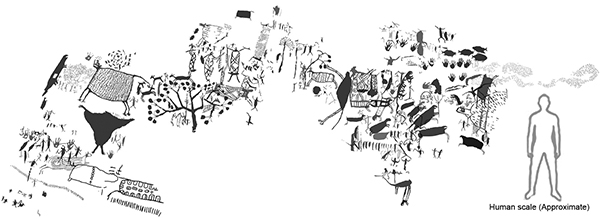 |
| Fig. 3. Transcription of a portion of rock paintings from the Abrigo de Los Jaguares (Chiribiquete). Drawing by Diego Martinez based on a photo by Carlos Castaño Uribe, 2005. |
Regarding the dating of rock
art, Castaño & Van der Hammen (2006: 41) assert that the rock paintings of Chiribiquete were made between 450 and 1450 AD although some findings apparently suggest the
existence of older rock paintings. This date is based on the presence of remains of pigments and fragments
of rocks with paintings detached from rock-shelters and stratigraphically associated with charcoal and other archaeological artifacts. Unfortunately, no
analysis of pigments from archaeological deposits and murals has been carried
out in order to confirm that the pigments are in fact the remains of paintings.
This means that definite confirmation of the age of the Chiribiquete rock paintings has to wait until a specialised pigment analysis has been done.
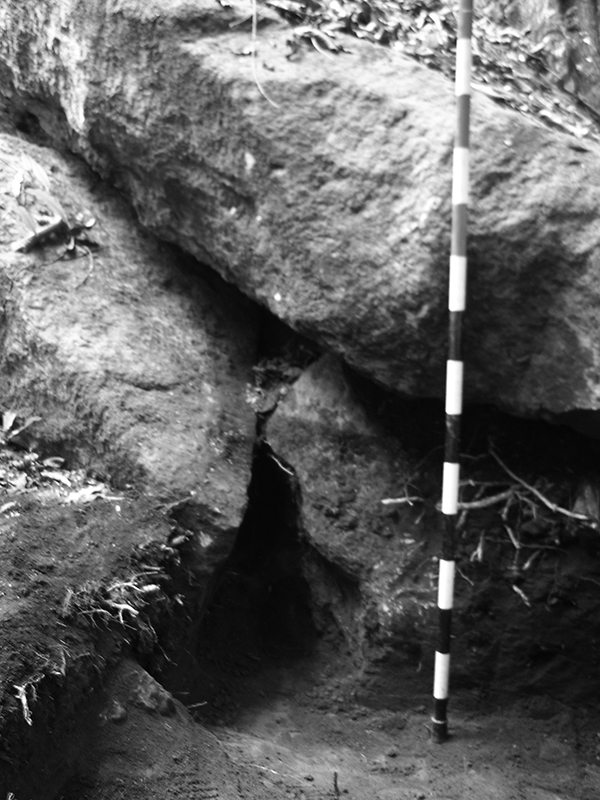
Archaeological excavations
at El Colegio (Fig. 4) have made possible the dating
of activities associated with rock art use. Two kinds of activities seem to be
related to the placing of offerings at the edges of rocks with petroglyphs. In
fact, fragments of rocks with petroglyphs and cupules as well as cobbles have
been excavated close to the main rocks (Argüello 2009). Other activities such as hearths have
also been identified in the immediate vicinity of petroglyphs. Pottery sherds associated with these activities have been dated to
between 2100 and 1100 BP, suggesting the period during which petroglyphs were
probably used.
 |
| Fig. 4. Cavity in a rock with petroglyphs in which some “offerings” were found. El Colegio (Cundinamarca). Pedro Argüello. |
In short, contrary to the
belief that a traditional archaeological approach to rock art is futile, both
the Chiribiquete and El Colegio cases have demonstrated how the responsible application of archaeological
methods is a powerful tool for answering basic questions about the more complex
problems that remain. Unless we decide to opt for the uncritical application of
universal theories, we have to accept the necessity of building a solid basis
for the comprehension of rock art, part of which is the uncertain chronology.
Beyond academic concerns,
perhaps one of the most important results of the above-mentioned archaeological
projects is the re-evaluation of the definition of rock art site (Martínez, 2005b). It has
been traditionally considered that the site is just the rock with paintings or
petroglyphs; but now it is necessary to accept that the archaeological deposits
around these rocks are part of it as well. Such a statement implies new
considerations regarding the protection of rock art sites because it is a
common practice to loot these sites in search of Indian treasures. Therefore, documentation projects should be accompanied by
an educational campaign in order to avoid that new sites could be vandalized.
Rock Art as Cultural Heritage. Conservation, education and presentation
According to the Colombian
Political Constitution (1991), every archaeological object belongs to the State.
Rock art is considered a constituent part of the National Archaeological Heritage
and is dealt with by the Special Regime of Archaeological Heritage (art. 54 t.IV, Dec.763-2009) whose
principal objectives are protection, recovery, conservation and presentation.
This legal framework, developed during the last decade, has made possible some
progress in the conservation of archaeological material, although a convincing
State policy is still necessary. Although the law is mandatory about the obligation
to carry out CRM archaeology in almost every civil project involving soil
removal, the expansion of the urban frontier is still perilous for both rock
art and its surrounding context, mainly because companies working in civil
projects do not know the law or arbitrarily violate it. But even worse, many
rock art sites are destroyed through lack of knowledge about the correct
management of this cultural resource by archaeologists practising CRM.
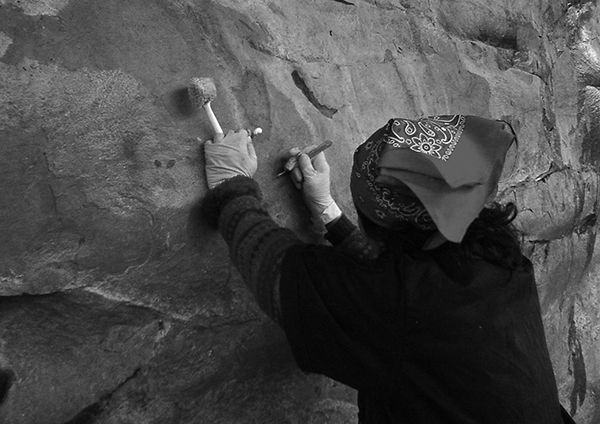
Concerns about the
preservation of rock art have been a growing field of interest in recent years.
The broad variety of issues that have been taken into account could be grouped
into a number of different topics. The most consistent effort has been focused
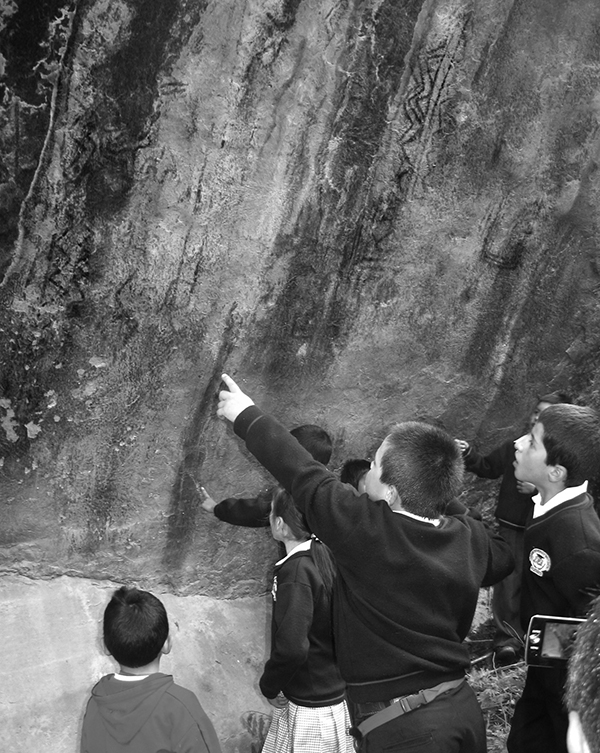
on the presentation of rock art. Target groups have been diverse, although
systematic processes have put an emphasis on local administrative authorities
(Botiva 2000), schoolteachers and students (Martínez &
Botiva 2004) as well as organised community groups
(Fig. 5). The scope of these educational projects was initially limited to the
centre of the country, and they were directed by the State agency responsible
for protecting archaeological heritage (Instituto Colombiano de Antropología e Historia – ICANH) as part of an educational project
directed by archaeologist Alvaro Botiva. Since then, some similar attempts have
slowly been adopted in other regions (Gómez & Barona 2007). Although it is
difficult to evaluate the real effect of such educational programmes,
it is hopeful that some of the groups involved are using these materials as a
“point of departure” for demanding that administrative authorities pay attention
to rock art conservation, and as a source of knowledge about the topic. On the
other hand, the growing visibility of rock art has led some of these embryonic
groups to include it in projects of cultural and ecological tourism. However,
this might turn into a double-edged weapon, because it could allow rock art to
be protected by an informed community while exposing it to perils related to
poorly informed tourists.
 |
| Fig. 5. Schoolchildren participating in a rock art workshop. Zipacón (Cundinamarca). Diego Martínez C., 2009. |
 |
| Fig. 6. Conservation work (graffiti removal) in Parque Arqueológico de Facatativa (Cundinamarca). María Paula Álvarez, 2005. |
We also have to consider the
way people think about and relate themselves to material from prehispanic communities. Colombia is a country of diverse
“ethnic” groups that have been differentially integrated (and sometimes just
excluded) in a failed attempt at national construction. Some of these groups,
frequently dubbed “ethnic minorities”, have a long history of struggle against
central State administration in an effort to maintain their lands, autonomy and
identity. An important component of these struggles consists of memory recovery
and the construction of historical narratives, most of them strongly related to prehispanic material such as rock art (e.g. Dagua et al. 1998: 65-66). In consequence, different and sometimes conflicting “versions”
about heritage ownership and management have emerged (Londoño 2003).
 |
| Fig. 7. A “neo-Muisca” performing an offering with fermented maize beer –chicha– on a rock with petroglyphs in Sasaima (Cundinamarca). Diego Martínez C., 2009 |
With respect to the way in
which rock art is involved in claims by new social movements, there are three
topics that seem to be pre-eminent: concerns about the necessity of protecting
rock art sites, new attempts to explain rock art meanings, and the use of rock
art sites to perform different sorts of activities. The first two topics are
very welcome in rock art research, but the third brings a series of necessary
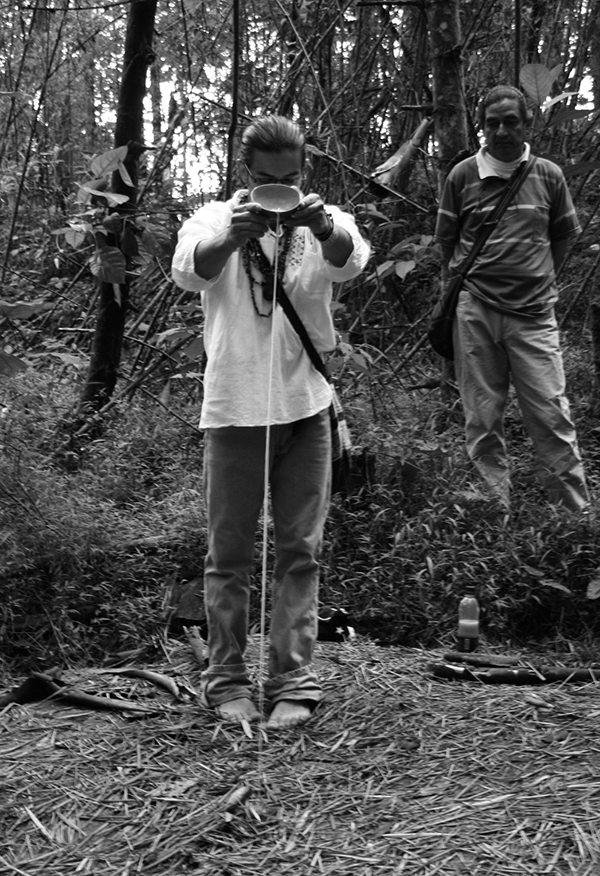
reflections. For example, Gómez (2009) relates the use of the rock paintings in
the Archaeological Park of Facatativá by a “neo-Muisca” priest in order to communicate with Muisca deities and to be instructed by them. As a
consequence, an increasing number of activities are taking place around rock
art murals. Some of them, like offerings and pledges, as far as we know, pose
no threat to rock art, but others like incense burning may cause damage to rock
paintings. In fact, recent inspections in the Archaeological Park of Facatativa have verified the existence of debris from
ceremonial activities performed by different groups (Fig. 8) (Martínez 2010).
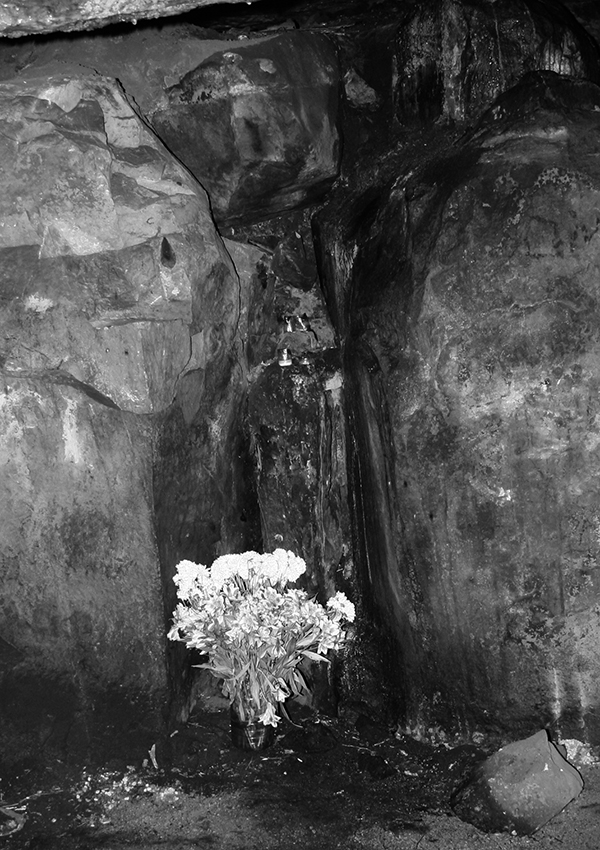 |
| Fig. 8. Offerings (flowers, candles, tobacco, contemporary pottery sherds) in a rock-shelter in the Parque Arqueológico de Facatativa (Cundinamarca). Diego Martínez C. 2009. |
Conclusion
Until recent years it was assumed
that Colombian rock art deserved only a marginal place in scholarly works which summarised knowledge
about this topic in South America (Dubelaar 1984; Schobinger 1997). This situation was due to several factors
such as the low flow of academic information between South American countries,
but more especially to the lack of comprehensive studies about Colombian rock
art that was almost limited to a few site descriptions. Luckily, this situation
has changed considerably as a result of considerable efforts by a growing group
of researchers interested in rock art studies. The use of new information
technology has made the diffusion and circulation of information about rock art
easier and cheaper. For instance, internet sites like
Rupestreweb (www.rupestreweb.info) have effectively integrated scholars in
Latin America and have become a tool for a very diverse audience. In addition, this tool allows some
researchers to make their studies known to a wider audience (Fig. 9).
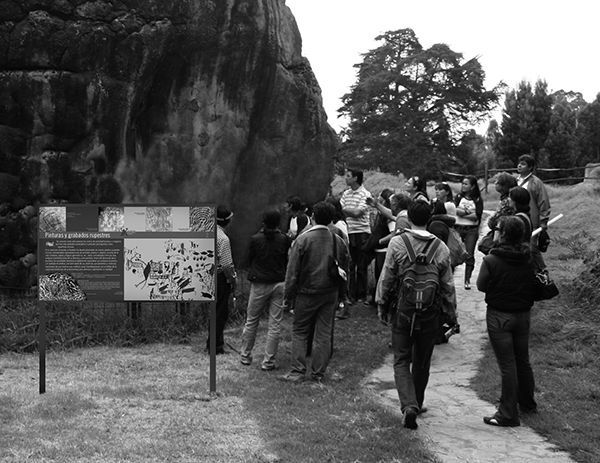 |
| Fig. 9. Interpretative pathway in the Parque Arqueológico de Facatativa (Cundinamarca). Script and design Martinez & Botiva, 2008. |
The increasing volume of
available information about Colombian rock art has raised awareness of its
diversity and complexity. More than just “discoveries”, each new site, or group
of them, presents researchers with a new set of problems, and makes rock art
explanation ever more challenging. Two examples illustrate this point. Recent
discoveries of rock paintings in white and black in protected zones of
rock-shelters have permitted researchers to postulate that the pre-eminent
occurrence of red paintings in the centre of Colombia is a consequence of a taphonomic process (Argüello & Martínez 2004: Fig. 10) instead of a prehispanic cultural choice as was previously assumed
(Cabrera 1969). The finding of rock paintings inside some caverns in western
Colombia (Pino & Forero 2008), a region in which only petroglyphs in open-air sites had previously been
found, demonstrates that the view of the preferential spatial distribution of
different kinds of art is mostly related to the effect of the biased way in
which rock art is sought.
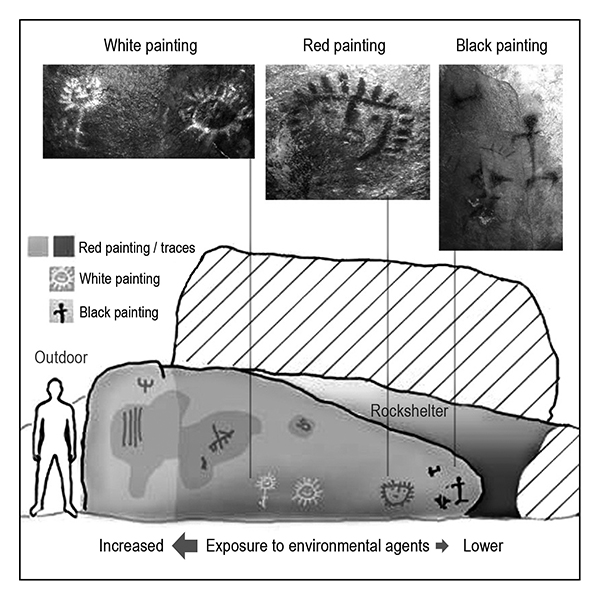 |
| Fig. 10. Differential distribution of rock paintings produced by taphonomic processes, Sutatausa (Cundinamarca). After Argüello & Martínez 2004. |
While researchers are
occupied by their goal of explaining rock art, they are also increasingly
concerned with issues related to rock art conservation. Nowadays it is not
possible to be involved in rock art research without facing problems associated
with the survival of the object of study. But it is not only a question of the
survival of the object itself; there are also the complex considerations such
as nationalism, heritage, and the economic use of prehispanic material. In short, Colombian rock art research is both a challenging endeavour and a productive field for exploring and
confronting current debates about this topic.
We are grateful with Carlos Castaño Uribe and María Paula Álvarez for provide photos for Figures 4 and 6 respectively
and James Williams for helping with English language in an early version of
this text.

—¿Preguntas, comentarios? escriba a: rupestreweb@yahoogroups.com—
Cómo citar este artículo:
Arguello García, Pedro; Martínez Celis, Diego Rock Art research in Colombia
En Rupestreweb, http://www.rupestreweb.info/rockartincolombia.html
REFERENCIAS
Álvarez, M.
& Martínez, D. 2004. Procesos de documentación y conservación en los conjuntos pictográficos
19 y 20, Parque arqueológico de Facatativá. Informe de investigación. ICANH: Bogotá.
Alzate, N. &
Osorio, C. 2009. Aproximación a una
contextualización histórica y cultural de los petroglifos del Valle de Aburra.
Tesis/Informe de práctica. Tesis (Antropologo). Universidad de Antioquia.
Facultad de Ciencias Sociales y Humanas. Departamento de Antropologia: Medellín.
Andrade, J., León,
V. & Gonzalez, E. 2006. Pinturas
rupestres en palermo, huila. Testigos silenciosos en los santuarios católicos. Rupestreweb. Available at: http://www.rupestreweb.info/palermo.html
Argüello, P. 2006. Restauración y educación en
el arte rupestre. Notas sobre un caso colombiano (Parque Arqueológico de
Facatativá). Rupestreweb. Available at: http://rupestreweb.info/facaresta.html
Argüello, P. 2008. Tendencias recientes en la investigación del arte
rupestre en Suramérica. Una síntesis crítica. Arqueología Suramericana 4
(1): 53-75.
Argüello, P. 2009. Archaeology of rock art: a
preliminary report of archaeological excavations at rock art sites in Colombia. Rock Art Research 26
(2): 139-64.
Argüello, P. &
Martínez, D. 2004. Procesos tafonómicos
en el arte rupestre: un caso de conservación diferencial de pinturas en el
altiplano cundiboyacense, Sutatausa, Colombia. Rupestreweb. Available at: http://rupestreweb.info/sutatausa.html
Baena, J.,
Carrión, E. & Blasco, C. 2006.
Hallazgos de arte rupestre en la Serranía de Chiribiquete, Colombia. Misión
arqueológica 1992. Rupestreweb. Available at:
http://rupestreweb.info/chiribiquete.html
Bonilla, M. 2003. Programa de reconocimiento y prospección
arqueológica para el E.I.A y P.M.A. del área de influencia del proyecto
construcción y operación del propanoducto y planta almacenadora de gas licuado
GLP Mondoñedo. (m.s). Velogas: Bogotá.
Botiva, A. 2000. Arte rupestre en
Cundinamarca, patrimonio cultural de la nación. Gobernación de
Cundinamarca, ICANH: Bogotá
Cabrera,
W. 1969. Monumentos rupestres de Colombia (Cuaderno primero: Generalidades, algunos conjuntos pictóricos de
Cundinamarca). Revista Colombiana de Antropología. 14: 81-167. Bogotá.
Castaño-Uribe, C. & Van der
Hammen, T. 2006. Arqueología de visiones y
alucinaciones del Cosmos felino y chamanistico de Chiribiquete. Parques
Nacionales Naturales de Colombia, Corpacor, Fundación Tropenbos: Bogotá.
Chippindale, C. & Taçon, P. (eds) 1998. The Archaeology of Rock-Art.Cambridge
University Press: Cambridge.
Correa, J. 2002. Los
muiscas del siglo XXI en Chía: el Resguardo Indígena de Fonquetá y Cerca de
Piedra. Departamento de Cundimarca, Secretaría de Cultura: Alcaldía Popular de
Chía.
Correal,
G. &
Van der Hammen, T. 1977. Investigaciones arqueológicas en los
abrigos rocosos del Tequendama (Vol. 1). Fondo de Promoción de la Cultura
del Banco Popular: Bogotá.
Dagua, A., Aranda, M. &
Vasco, L. 1998. Guambianos: hijos
del arcoiris y del agua. Fondo Promoción de la Cultura, Fundación
Alejandro Angel Escobar, CEREC:
Bogotá.
Delgado, C. &
Mercado, R. 2010. La blasonería y el arte
rupestre Wayuu.Rupestreweb. Available at: http://www.rupestreweb.info/wayuu.html
Dubelaar,
C. 1984. A study on South American and
Antillean petroglyps.Royal Institute of Linguistics and Anthropology: New Jersey.
Flórez, A. 2009. Piedras vivas: manifestaciones rupestres y memoria
oral en el
valle de Sibundoy, corredor milenario entre andes y selva. Rupestreweb. Available at:
http://www.rupestreweb.info/piedrasvivas.html 2009
Gómez, F. 2009. Los chyquys de la nación muisca chibcha: ritualidad, re-significación y memoria.
Universidad de los Andes, Facultad de Ciencias Sociales-CESO, Departamento de
Antropología: Bogotá.
Gómez, T. &
Barona, A. 2007. Cartilla Pedagógica de arte
rupestre. Fundación Wayta Pachamama – Gobernación del Valle del
Cauca: Cali.
Gutiérrez, O. (ed.) 1999. Los muisca: un pueblo en reconstrucción. Cabildo
Indígena Musica de Suba. Foro Memoria e Identidad de los Indígenas Muisca de la
Sabana de Bacatá: Pueblo en Reconstrucción. Secretaría de Gobierno, Subachoque; Cabildo Indígena de Suba Resguardo
Muisca. Imprenta distrital: Bogotá
Hernández, D. 1998. Prospección Arqueológica y levantamiento de petroglifos en el
Municipio de Itaguí. Tesis/Informe de Tesis (Antropólogo). Universidad de
Antioquia. Facultad de Ciencias Sociales y Humanas. Departamento de
Antropología: Medellín.
Jaramillo, L. & Oyuela-Caycedo, A. 1995. Colombia:
a quantitative analysis, pp. 49-68 in (A. Oyuela-Caycedo, ed.) History of Latin
American archaeology. Worldwide Archaeology Series 14, Avebury: Aldershot.
Langebaek, C. & Piazzini, C. 2003. Procesos de poblamiento en
Yacuanquer-Nariño: una investigación arqueológica sobre la microverticalidad en
los andes colombianos (siglos X a XVIII d.C.). Interconexión Eléctrica
S.A.: Bogotá.
Londoño, W. 2003. Discurso jurídico versus discurso cultural: el
conflicto social sobre los significados de la cultura material prehispánica. Boletín Museo del Oro 51. Available at:
http:/www.banrep.gov.co/museo/esp/boletin
López, E. & Velázquez, A. 2009. Aproximación al estudio iconográfico de las manifestaciones rupestres
en el municipio de Tamesis, Antioquia. Tesis/Informe de práctica. Tesis
(Antropólogo). Universidad de Antioquia. Facultad de Ciencias Sociales y
Humanas. Departamento de Antropologia: Medellín.
Martínez, D.
2005a. Propuesta para la documentación
general de yacimientos rupestres: el petroglifo de la piedra de Sasaima,
Cundinamarca (Colombia).Rupestreweb. Available at:
http://rupestreweb.info/sasaima.html
Martínez, D. 2005b. Response to Munoz. The debate between GIPRI and ICANH-Double ethics in rock art research. Rock Art Research 22 (2): 202-03.
Martínez, D. 2006. Propuesta para un análisis iconográfico
de petroglifos: la piedra de Sasaima, Cundinamarca (Colombia). Rupestreweb. Available at: http://rupestreweb.info/sasaima2.html
Martínez, D. 2008a. Vallas
informativas y arte rupestre. ¿Visibilización de lo público o exposición de lo
frágil? Rupestreweb. Available at: http://www.rupestreweb.info/vallas.html
Martínez, D. 2008b. Arte rupestre, tradición textil y
sincretismo en Sutatausa (Cundinamarca). Rupestreweb Available at: http://www.rupestreweb.info/sutatextil.html
Martínez, D. 2010a. “Patrimonio cultural: no dañar” Dinámicas
y agentes en la relación patrimonio, cultura y sociedad. A propósito del arte
rupestre de la Sabana de Bogotá. Rupestreweb. Available
at: http://www.rupestreweb.info/pcys.html
Martínez, D. 2010b. Territorio, memoria y comunidad.
Aproximación al reconocimiento patrimonial del arte rupestre precolombino de la
sabana de Bogotá
. Rupestreweb. Available at:
http://www.rupestreweb.info/tmyc.html
Martínez, D. &
Argüello, P. 2003. Documentación del
yacimiento rupestre de Sáchica, Boyacá: informe final (m.s.) Calizas
y Agregados Boyaca S.A.: Bogotá.
Martínez, D. &
Botiva, A. 2004. Manual de arte rupestre
de Cundinamarca. ICANH – Gobernación de Cundinamarca, Segunda
Edición. Bogotá.
Martínez, D. &
Botiva, A. 2008. Exposición. Arte
rupestre Parque arqueológico de Facatativá. Patrimonio cultural, memoria e
identidad. Rupestreweb. Available at:
http://www.rupestreweb.info/expofaca.html
Martínez, L. &
Hernández, H. 2006. Identificación y
Caracterización del patrimonio Rupestre asociado a las áreas naturales de la
jurisdicción de Corantioquia. (m.s.), Corantioquia: Medellín.
Mora, S. 2003. Early
inhabitants of the Amazonian tropical rain forest: a study of humans and
environmental dynamics. Department of Anthropology, University of
Pittsburgh: Pittsburgh.
Moreño, A. 2009. Pensamiento ancestral y petroglifos. Una aproximación semiótica al
arte rupestre de Piragua –Cascajal en Timaná, Huila. Gobernación del
Huila. Secretaría de Cultura y Turismo. Fondo de Autores Huilenses: Neiva.
Muñoz, G. 2006. Patrimonio
rupestre. Historia y hallazgos. Gobernación de Cundinamarca, Alcaldía
Cívica de El Colegio: El Colegio.
Navas, A. &
Angulo, E. 2010. Los guanes y el arte
rupestre xerirense: la revelación de lo desconocido y el redimensionamiento de
lo antes firmado. Con la más completa muestra y análisis del Arte Rupestre
Mesetario realizado hasta el momento. Fundación El Libro Total: Bucaramanga.
Piazzini, C.,
Lozano, G. & López, L. 2002. Proyecto
hidroeléctrico Miel I: programa de rescate arqueológico. Informe final (m.s.) Informe presentado al Instituto Colombiano de Antropología / Ejemplar 2
en Cd-Rom bajo CD-ARQ-1163. Isagen, Strata: Medellín.
Pino, J. &
Forero, J. 2008. Acercamiento arqueológico al estudio de las expresiones
rupestres en un contexto de cavernas en el departamiento de Antioquia,
Colombia. International Journal of South American
Archaeology 2, February.
Pradilla, H. & Ortiz, F. 2002. Rocas
y petroglifos del Guainía. Escritura de los grupos arawak-maipure.
Fundación Etnollano, Museo Arqueológico de Tunja, Universidad Pedagógica y
Tecnológica de Colombia.
Pradilla, H. &
Villate, G. 2010. Pictografías,
moyas y rocas del Farfacá. Museo Arqueológico de Tunja, Universidad
Pedagógica y Tecnológica de Colombia, Gobernación de Boyacá.
Quijano, A. 2007. El
pictógrafo quillacinga de “El higuerón” como marcador del solsticio de verano.
Empresa Editora de Nariño – EDINAR: San Juan de Pasto.
Quijano, A. 2010. Estudio matemático del diseño Precolombino de la
espiral en el arte rupestre des noroccidente del municipio de Pasto (Colombia). Rev.
Acad. Colomb. Cienc.
Xxxiv (no. 130): 53-70.
Ramírez, G. 2009. Petroglifos en el paisaje o paisaje en los
petroglifos.
Propuesta para analizar la apropiación cultural del paisaje
desde el
arte rupestre en la vertiente occidental de
Cundinamarca.
Rupestreweb. Available at: http://www.rupestreweb.info/anolaima.html
Restrepo, C. 2003. Proyecto de desarrollo vial doble calzada
Armenia-Pereira-Manizales, - Autopista del Café. (m.s.) Autopista del
Café, Instituto Nacional de Vías: Pereira.
Romero, M. 2003. Malikai, el canto del malirri. Formas
narrativas de un mito amazónico. Fundación Parature: Cerec.
Rodríguez, E. &
Pescador, L. 2004. Manifestaciones de
arte rupestre en la vereda El Fute, municipio de Bojacá: reconocimiento y
prospección arqueológica en el relleno Sanitario nuevo Mondoñedo. (m.s)
CISAN: Bogotá.
Secretaria de
Cultura de Norte de Santander 2007. Inventario
arqueológico, paleontológico y de arte rupestre de Norte de Santander, Colombia.
Informe presentado al Instituto Colombiano de Antropología e Historia, ICANH.
Instituto de Cultura y Turismo: Pamplona.
Schobinger, J. 1997. Arte
prehistórico de América. Consejo Nacional para la Cultura y las Artes-Jaca
Books: México.
Whitley, D. 2005. Introduction to Rock Art Research. Left Coast Press:
Walnut Creek.